Conference papers
...
[2024-11-21 23:45 Beijing Time] Zhibin_Regularized_Cholesky.pdf
Published in
Zhang, Z., Potekhin, R.N. & Lyashev, V.A. Regularized Linear MU-MIMO Equalizer and Its Robustness. Probl Inf Transm 61, 95–109 (2025). https://doi.org/10.1134/S0032946025020024 [Q3] / K1
[2024-11-28 17:36 Beijing Time] Computationally_Efficient_Tensor-Based_MIMO_Precoder.pdf
In this paper, a novel Tensor-based MIMO
precoder algorithm that significantly reduces computational
complexity compared to the classical SVD precoder is
proposing. This approach is based on the well-known tensor
decomposition (Tucker decomposition), which allows to
represent and process of multidimensional data arrays
efficiently. The approach significantly reduces the
dimensionality of the problem leading to a substantial decrease
in computational costs. Numerical experiments demonstrate
that the proposed Tensor-based MIMO precoder provides
comparable performance to the SVD precoder while
significantly reducing computational complexity.
[2024-11-28 17:44 Beijing Time] Virtual_Sectorization_to_Enable_Hybrid_Beamforming_in_mm-Wave_mMIMO.pdf
Hybrid beamforming (HBF) is a key technology
to enable mm-wave Massive multiple-input multiple-output
(mMIMO) receivers for future-generation wireless communications.
It combines beamforming in both analog (via phase
shifters) and digital domains, resulting in low power consumption
and high spectral efficiency. In practice, the problem of joint
beamforming in multi-user scenarios is still open because an
analog beam can’t cover all users simultaneously.
In this paper, we propose a hierarchical approach to divide
users into clusters. Each cluster consists of users inside a virtual
sector produced by the analog beamforming of an HBF-based
mMIMO receiver. Thus, inside each sector, a lower-cost digital
beamforming serves a limited number of users within the same
cluster.
Simulations with realistic non-line-of-sight scenarios generated
by the QuaDRiGa 2.0 demonstrate that our methods outperform
standard FFT-based alternatives and almost achieve SVD-based
beamspace performance bound.
[2024-11-28 17:45 Beijing Time] Probabilistic_Examination_of_Least_Squares_Error_in_Low-Bitwidth_Cholesky_Decomposition.pdf
In this paper, we propose a new approach to
justify a round-off error impact on the accuracy of the linear
least squares (LS) solution using Cholesky decomposition. This
decomposition is widely employed to inverse a matrix in the linear
detector of the Multi-User multi-antenna receiver. The proposed
stochastic bound is much closer to actual errors than other
numerical bounds. It was tested with a half-precision format and
validated in realistic scenarios. Experimental results demonstrate
our approach predicts errors very close to those achieved by
simulations. The proposed approach can be employed to analyze
the resulting round-off error in many other applications.
Magazine articles
...
[2024-10-28 23:45 Moscow Time] DSP_2024-03_Lyashev.pdf
Today, active antenna arrays are increasingly being used in wireless communication. The systems become highly selective in
space, which makes them sensitive to errors in channel estimations. The paper considers the main problems of MIMO systems in
which it is not possible to evaluate the channel using direct methods based on pilot signals. Implicit estimation methods require a
compressed representation of channel state information, which imposes limitations on their accuracy. A method of iterative recovery
of channel information from a compressed representation is proposed, which has an improved efficiency of channel matrix acquisition
and the effect of error smoothing.
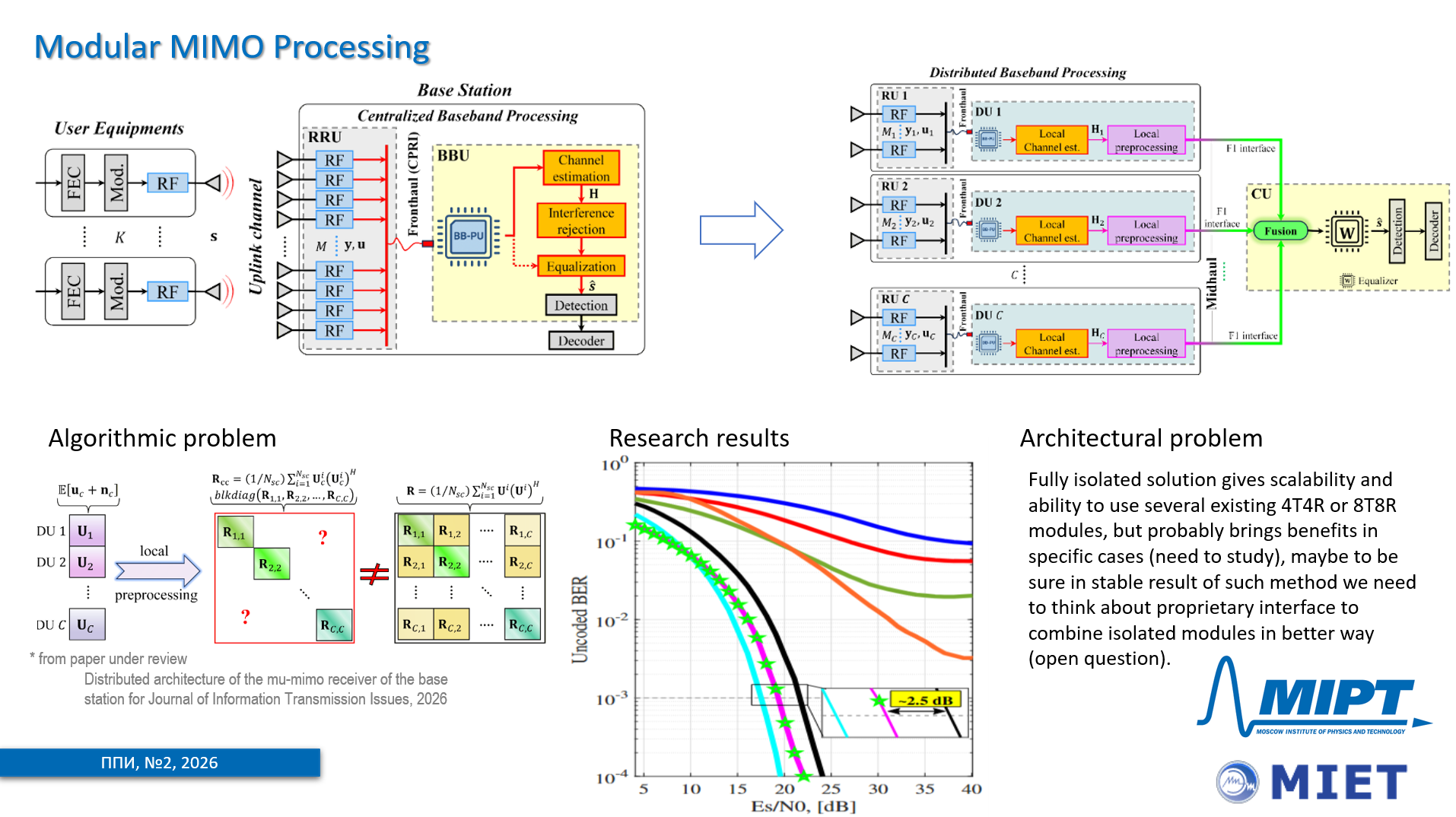
[2026-02-24] Modular MIMO Processing
In publishing. Brief idea intro here.
|
Materials for seminars
Seminar on MSU.CMC / 2026-03-02 /
This presentation introduces Zadoff-Chu (ZC) sequences, a class of mathematical signals with Constant Amplitude Zero Auto-Correlation (CAZAC) properties. It highlights their fundamental role in modern wireless communications, particularly for synchronization and random access in LTE and 5G networks.
Finally, the presentation outlines a concrete research and development task based on the paper by Tianhao Li et al. The goal is to implement and potentially improve a robust detection algorithm that mitigates these Doppler effects. The expected outcomes include a working MATLAB/Octave simulation, a conference paper, and a potential internship opportunity with the company YADRO.
FILE: 2026-03-02_ZC_VMK-seminar.zip
Cross-attention receiver
Применение механизмов кросс‑внимания в приёмнике для обработки OFDM-сигналов
от распределённых точек доступа
Cross-Attention in OFDM Receivers for Distributed Access Points
Краткое описание темы:
Работа посвящена преодолению ограничений классических приёмников
(независимая обработка AP, потребность в точной оценке канала) за счёт нейросетевого подхода.
Предлагается рассмотреть архитектуру приемника-трансформера с механизмами кросс‑внимания,
обеспечивающую совместное декодирование OFDM-сигналов от множества скоординированных AP без
явной оценки канала.
FILE: cross-attention receiver.pdf
Обзор посвящён применению машинного обучения на физическом уровне MIMO-систем для 5G/6G.
Традиционные методы уступают место data-driven и гибридным подходам, что позволяет повысить
точность оценки канала, упростить детектирование сигналов и сжатие информации о состоянии
канала (CSI). Рассматриваются архитектуры на основе CNN, RNN/LSTM, автоэнкодеров
и трансформеров. Основные вызовы — обобщение моделей на новые условия и дефицит данных,
для их преодоления предлагаются мета-обучение, генеративные модели и трансфер знаний.
Тренд развития — переход от каскадной обработки к сквозным нейросетевым решениям, включая архитектуры,
аналогичные большим языковым моделям (CSI-GPT), для универсальной обработки радиосигналов.
FILE: ML-in-PHY_MIMO.pdf
Cognitive Satellite-Terrestrial Network с защитой наземной сети
О применении методов когнитивного радио (CR) для интеграции низкоорбитальных (LEO) спутниковых сетей с наземной инфраструктурой
On the application of cognitive radio (CR) methods for integrating low-orbit (LEO) satellite networks with ground infrastructure
Краткое описание темы:
Интеллектуализация управления спектром (DSM) создает "правила игры" и "сенсорную систему", позволяющую когнитивным спутникам ориентироваться в частотном пространстве. В свою очередь, передовые технологии, такие как RIS и NOMA, выступают в роли "инструментов" или "эффекторов", которые позволяют этим спутникам максимально эффективно использовать доступные ресурсы, обслуживая больше пользователей с более высоким качеством, оставаясь при этом "невидимыми" для первичных пользователей спектра (GEO, TN). Их синергия является ключом к созданию по-настоящему гибких, масштабируемых и эффективных гибридных спутниково-наземных сетей будущего (6G).
FILE: Cognitive Satellite-Terrestrial Network с защитой наземной сети.docx
|